

Traditional psychiatric care often fails adults with ADHD because it relies on rigid monthly visit schedules that clash with executive dysfunction. According to recent healthcare accessibility reports, nearly 60% of adults with ADHD report difficulty maintaining consistent treatment plans due to administrative friction and scheduling barriers. This systemic failure means that selecting the right provider is not just about medical credentials, but about finding a care model that accommodates the unique cognitive needs of neurodivergent professionals. The right psychiatrist reduces the burden of management, allowing you to focus on work and life rather than navigating insurance and pharmacy hurdles.
Understanding ADHD-Friendly Care Models
When searching for a psychiatrist, the first distinction to make is between traditional fee-for-service models and specialized concierge or optimized care frameworks. Traditional models often require strict monthly appointments, which can be impossible for patients struggling with time blindness or executive dysfunction. If you miss an appointment, you may face cancellation fees or lose your slot, creating a cycle of anxiety and disengagement.
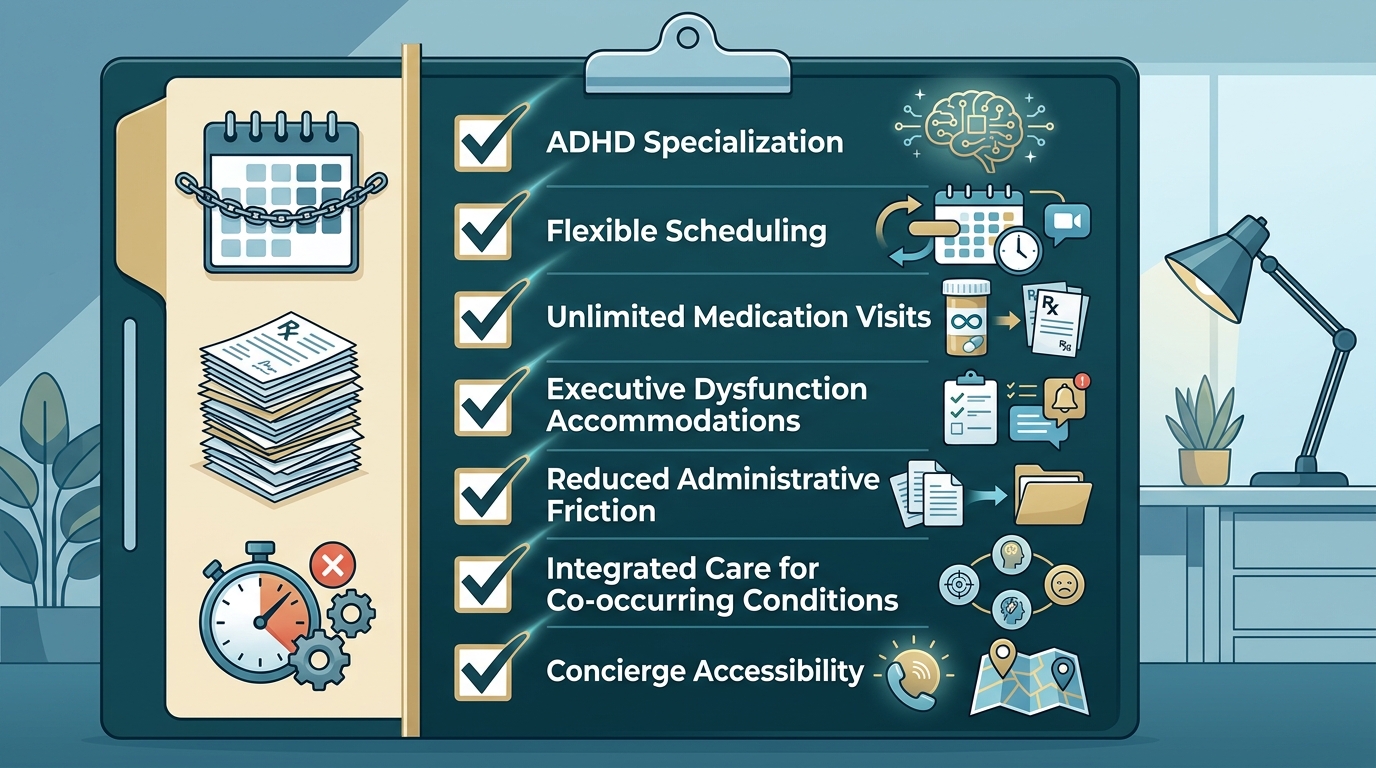
Concierge psychiatric care provides direct access to your provider, flexible scheduling, and unlimited medication visits. This model replaces the traditional visit-based structure with a patient-centered approach. It is designed for busy professionals who need responsive support without the administrative overhead. Optimized care focuses on reducing the overwhelm typically experienced in standard psychiatric practices.
Key indicators of an ADHD-friendly model include the ability to schedule last-minute appointments without penalties and the flexibility to cancel or reschedule freely. This flexibility is crucial for managing the unpredictable nature of ADHD symptoms. Providers who understand this dynamic prioritize continuity of care over rigid scheduling protocols.
Evaluating Provider Expertise and Credentials
Not all psychiatrists specialize in adult ADHD. Many general practitioners treat ADHD as a secondary condition, which can lead to suboptimal treatment outcomes. You should look for providers who explicitly state their expertise in adult ADHD and co-occurring conditions like anxiety and depression.
Board certification is a baseline requirement, but additional training in neurodiversity-affirming care is a significant advantage. For example, providers who are graduates of top-tier institutions like UCSF often bring rigorous, evidence-based methodologies to their practice. Provider credentials should be transparent and easily accessible on the practice website.
Experience matters significantly in psychiatric care. A provider who has been practicing since 2010 or earlier has likely navigated the evolving landscape of ADHD treatment and medication guidelines. Look for reviews that specifically mention the provider's ability to listen and validate the patient's experience. Patients often cite feeling understood as a primary reason for choosing a specific psychiatrist.
Access and Communication Channels
Communication barriers are a major reason for treatment dropout in ADHD populations. Traditional models often rely on phone trees or patient portals that require logging in and waiting for a callback. This friction can be insurmountable during a crisis or a moment of urgent need.
Direct communication via text, phone call, or email is a hallmark of high-performance psychiatric care. This direct line allows for rapid response times, which is critical for managing medication adjustments or urgent issues. Contact methods should be clearly listed, including direct cell numbers or dedicated texting lines.
Responsive care means receiving answers within hours, not days. For professionals, this responsiveness translates to maintaining productivity and reducing stress. Providers who offer multiple reminders via text and email help patients stay on track with appointments and medication refills, mitigating the effects of forgetfulness.
Pharmacy and Medication Support
One of the most significant challenges for adults with ADHD is navigating the pharmacy system, particularly for controlled substances like stimulants. Shortages and insurance denials are common and can disrupt treatment plans abruptly.
A competent psychiatrist will partner with your pharmacy to solve these issues promptly. They should have a deep understanding of current medication shortages and alternative protocols. For instance, data shows that ninety-five percent of patients respond equally well to a stimulant in the same family, allowing for flexible substitution during shortages.
Genetic testing may also be indicated to identify the best medications for your DNA. This personalized approach reduces the trial-and-error period often associated with psychotropic medications. Providers who offer genetic testing as part of their diagnostic process demonstrate a commitment to precision medicine.
Telehealth and Location Flexibility
The location of the psychiatrist's office and their telehealth capabilities are practical considerations that impact long-term adherence. For those in tech hubs like San Francisco, Seattle, or New York City, the ability to switch between in-person and remote care is essential.
Telehealth laws have expanded significantly, allowing for greater flexibility in where care is delivered. However, attending in-person can make starting care at a new pharmacy smoother, as pharmacists often verify the nature of the initial visit. Telehealth policies should be clearly outlined, including any state-specific licensing requirements.
Privacy is another critical factor. A discreet physical office that is not labeled as a psychiatric practice can provide high-level privacy for high-profile professionals. This discretion is often a key differentiator for clients who value confidentiality.
Financial Structures and Plans
Understanding the financial structure of psychiatric care is vital for avoiding surprise costs. Traditional models often involve co-pays, deductibles, and visit limits that can add up quickly. Concierge models typically offer a flat annual fee that covers unlimited visits and direct access.
Annual plans are designed to replace traditional visit-based care with a predictable cost structure. For example, basic plans may start at $1,999 per year for those stable on medications, while premium plans offering same-day availability and weekly psychotherapy may cost $13,999 per year. Concierge plans often allow the use of FSA and HSA cards, providing additional financial flexibility.
Insurance acceptance varies widely. Some practices accept major plans like Aetna and United, while others operate on a cash-pay basis. It is crucial to verify insurance coverage before starting care. If you have an out-of-network plan, ask if the provider can supply superbills for reimbursement.
Comparing Care Options
Choosing the right level of care depends on your current status, medication stability, and need for therapy. Below is a comparison of common care structures to help you evaluate your options.
| Plan Type | Target Audience | Key Features | Estimated Annual Cost |
|---|---|---|---|
| Basic Concierge | Stable on medications, recently relocated | Unlimited med visits, direct access, flexible scheduling | $1,999 |
| Starter Concierge | New to meds, needing adjustments, urgent issues | Priority access, pharmacy support, genetic testing | $3,999 |
| Premium Concierge | Premium access, same-day availability, therapy | Weekly psychotherapy, rapid response, full support | $13,999 |
| Traditional Insurance | Patients requiring insurance coverage | Co-pays, visit limits, potential delays | Variable |
This table highlights the trade-offs between cost, access, and service depth. For high-performing professionals, the premium of concierge care is often offset by the value of time saved and the reduction in administrative stress.
Key Takeaways
- Specialization Matters: Choose a psychiatrist who explicitly specializes in adult ADHD and co-occurring conditions like anxiety and depression.
- Communication is Key: Look for providers offering direct text or phone access, ensuring rapid response times for urgent needs.
- Flexibility Reduces Friction: Opt for models that allow last-minute scheduling and cancellation without penalties to accommodate executive dysfunction.
- Pharmacy Support: Ensure the provider actively partners with pharmacies to navigate stimulant shortages and insurance denials.
- Financial Clarity: Understand the difference between fee-for-service and annual concierge models to avoid surprise costs.
- Credentials and Experience: Verify board certification and years of practice, with a preference for providers experienced in neurodiversity-affirming care.
- Privacy and Discretion: Consider the physical location and labeling of the office if confidentiality is a primary concern.
Frequently Asked Questions
Will I be able to stay on my current medications?
Yes, many patients relocate to new cities like San Francisco or Seattle and continue their existing regimens. Uploading a diagnosis letter or providing your former provider's details helps ensure a smooth transition.
What if I have never been diagnosed with ADHD?
A thorough psychiatric evaluation will determine if ADHD is an accurate diagnosis. The provider will assess your childhood and adult experiences, as ADHD is a neurodevelopmental condition that begins in childhood.
Can I use an FSA or HSA card for concierge care?
Yes, most concierge plans allow the use of FSA and HSA cards. You should inform the provider when you meet so they can provide the necessary paperwork for reimbursement.
Do I have to come in-person for my first visit?
Not necessarily. Telehealth laws have expanded, allowing for remote initial visits in many states. However, an in-person visit can help establish care at a new pharmacy more smoothly.
How do I handle stimulant shortages?
Providers experienced in ADHD care actively monitor shortages and partner with pharmacies to find solutions. They may suggest alternative medications within the same family, which many patients respond to equally well.
What is the difference between a psychiatrist and a psychologist for diagnosis?
Psychiatrists can prescribe medication and manage treatment. Psychologists provide testing and diagnosis but cannot prescribe. If you need documentation for workplace accommodations, a psychologist's testing may be required, but a psychiatrist manages the ongoing treatment.
Can I start with a single evaluation before committing to a plan?
Yes, you can schedule and pay for a new patient evaluation only. If you decide to enroll in concierge care later, the evaluation fee is often deducted from the annual fee.
Next Steps
Choosing the right psychiatrist is a critical step in managing ADHD and reclaiming your productivity. By prioritizing providers who offer direct access, flexible scheduling, and specialized expertise, you can avoid the pitfalls of traditional care. If you are ready to explore a care model designed for busy professionals, schedule your initial visit online today. Take control of your mental health with responsive, ADHD-friendly psychiatric care.