

Hybrid ADHD care in San Francisco combines in-person psychiatric evaluations with ongoing remote medication management. This model offers the regulatory safety of face-to-face visits while providing the scheduling flexibility that busy professionals need. It stands out from purely virtual or purely in-person models by balancing compliance with convenience.
The Regulatory Reality of Controlled Substances
ADHD medications like Adderall and Vyvanse are Schedule II controlled substances. This classification imposes strict federal and state rules on how they are prescribed and dispensed. A purely remote model often faces friction because many pharmacists require an initial in-person visit to verify identity and assess for misuse. Hybrid care resolves this by scheduling the first evaluation in a physical office. This initial face-to-face interaction satisfies pharmacy requirements while allowing subsequent visits to occur via telehealth. The implication is that patients avoid the common pitfall of having a valid prescription rejected at the counter.
Scheduling Flexibility for Busy Professionals
Traditional in-only psychiatry often requires patients to take half a day off work for every follow-up. For professionals in San Francisco, Seattle, or New York City, this creates significant friction. Hybrid models leverage technology to eliminate unnecessary travel for routine check-ins. SF Psychiatric uses a HIPAA-compliant electronic health system that allows patients to reschedule or cancel visits without penalty. This flexibility is critical for maintaining treatment adherence. When a patient can message their provider directly to report a side effect or request a refill, the barrier to care drops significantly. The result is a more sustainable treatment relationship that fits into a demanding professional calendar.
Administrative Streamlining and Insurance Navigation
One of the biggest pain points in ADHD care is the administrative burden of insurance prior authorizations. In a standard model, patients often wait days or weeks for approval. Hybrid practices that integrate modern tools can expedite this process. For example, using electronic prior authorization platforms allows providers to secure insurance approval on the same day a prescription is submitted. This technology also streamlines the filling process by sending electronic prescriptions directly to pharmacies. By removing the need for phone tag and fax machines, hybrid care reduces the administrative stress that often leads patients to abandon treatment. The evidence suggests that tech-enabled workflows directly correlate with higher patient retention rates.
Continuity of Care Across Tech Hubs
Many professionals move between major tech hubs like San Francisco, Seattle, and New York City. A purely local in-person practice cannot follow a patient across state lines. Hybrid care models that are licensed in multiple states provide a solution for this mobility. SF Psychiatric is licensed in California, New York, and Washington, allowing patients to maintain their treatment relationship even after relocating. This continuity is vital for controlled medications, where switching providers can lead to gaps in supply. By maintaining a single point of contact, patients avoid the red flags that arise from multiple providers prescribing the same controlled substance. The implication is a stable, uninterrupted supply of medication regardless of geographic moves.
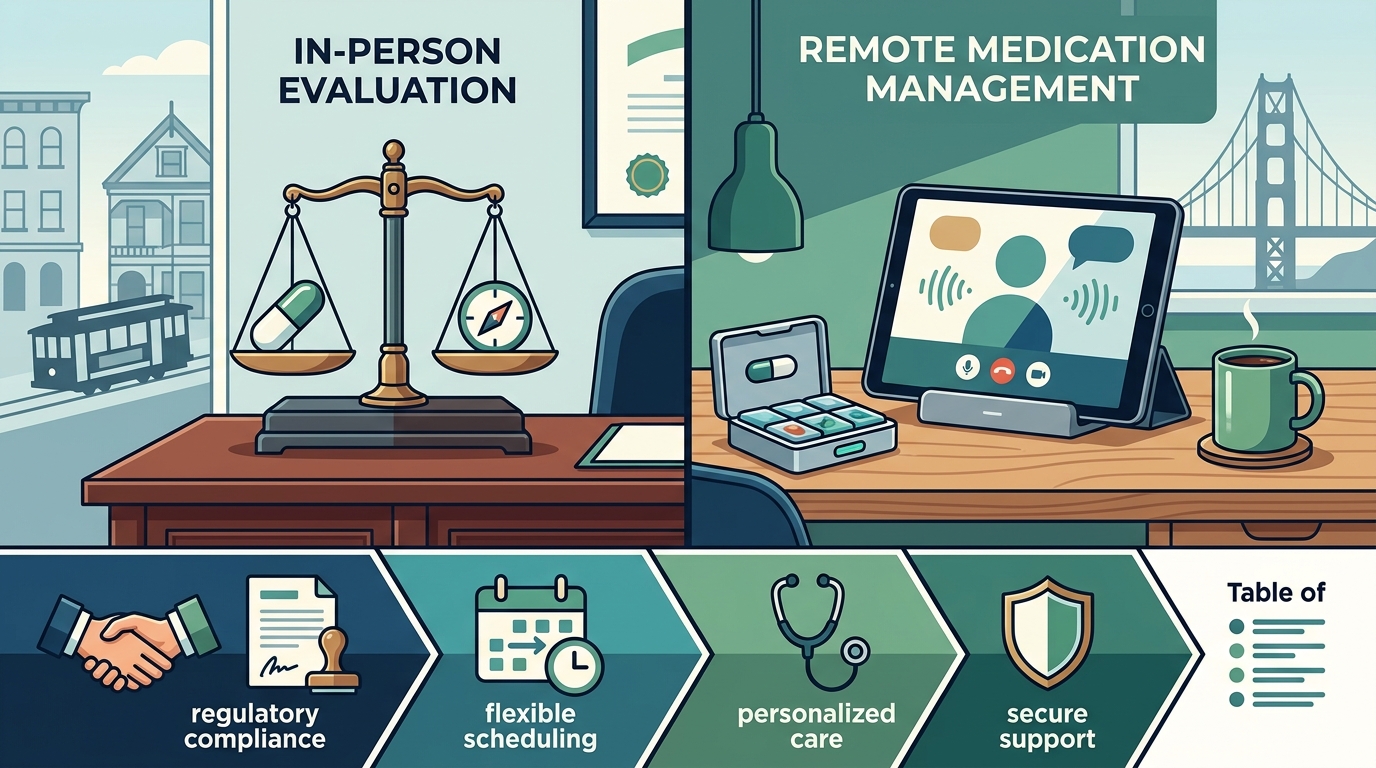
Comparative Advantages Over Pure Models
Key Takeaways
- Hybrid care combines in-person initial evaluations with remote follow-ups to satisfy pharmacy regulations.
- Schedule II controlled substances require strict adherence to prescribing rules, which hybrid models navigate effectively.
- Technology-enabled workflows, such as electronic prior authorizations, significantly reduce administrative delays.
- Multi-state licensing allows for continuity of care for professionals moving between tech hubs.
- Direct messaging and flexible scheduling improve treatment adherence for busy adults.
Frequently Asked Questions
Is hybrid ADHD care legal in California?
Yes, hybrid care is legal. The DEA has extended telehealth provisions, allowing for remote follow-ups after an initial in-person evaluation. This framework supports the hybrid model used by practices like SF Psychiatric.
Do pharmacists accept prescriptions from hybrid practices?
Generally, yes. Because the initial visit is in-person, pharmacists are more likely to accept the prescription. This avoids the common issue of telehealth-only prescriptions being rejected at the counter.
Can I switch from a pure telehealth provider to a hybrid one?
Yes, you can transfer your care. It is helpful to have documentation from your previous provider, including your diagnosis and medication history, to ensure a smooth transition.
What is the main benefit of hybrid care for professionals?
The main benefit is flexibility. You get the regulatory safety of in-person care without the time cost of traveling to the office for every routine check-in.
Does hybrid care work for people who move between states?
It works if the practice is licensed in both states. Practices licensed in California, New York, and Washington can provide continuity of care for patients moving between these hubs.