

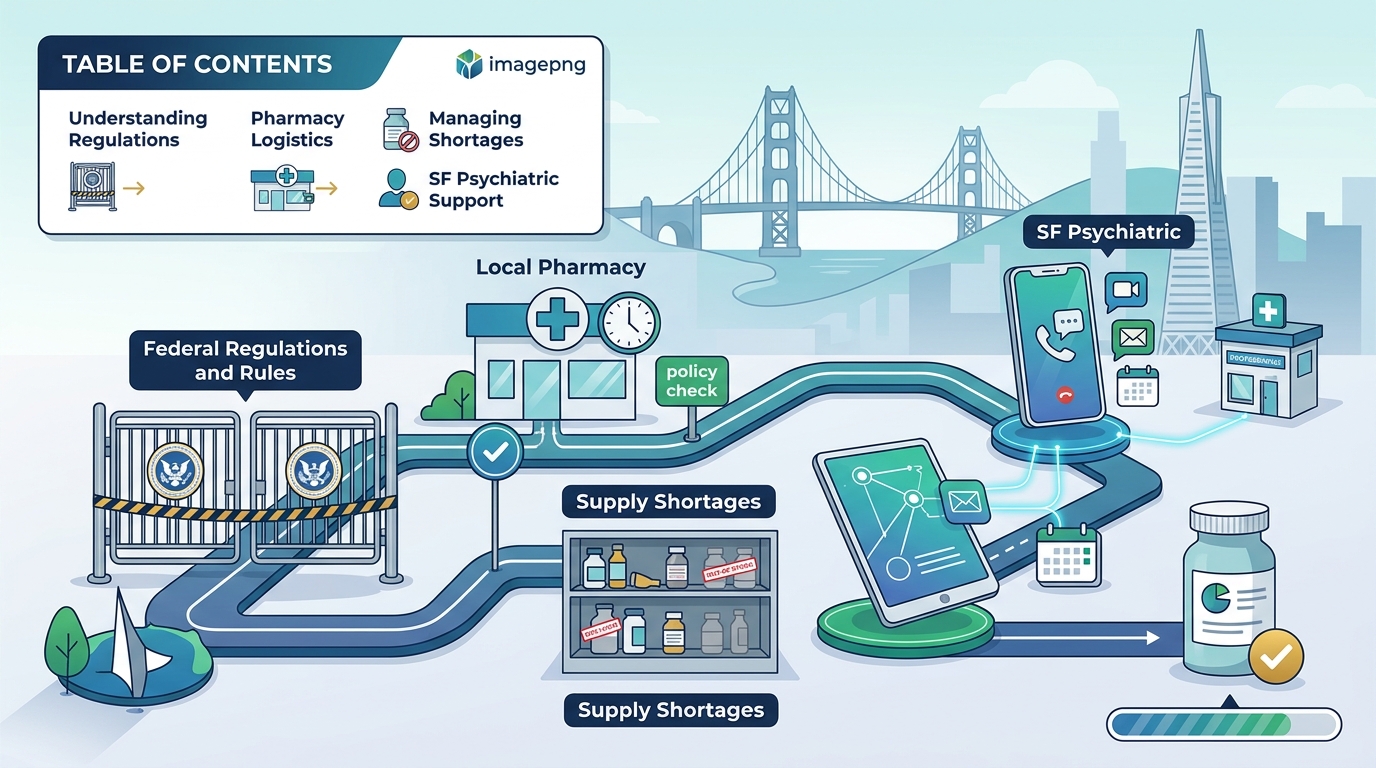
Getting ADHD stimulant medications in San Francisco requires navigating strict federal regulations, local pharmacy policies, and potential supply shortages. SF Psychiatric helps busy professionals manage these complexities by providing flexible, tech-enabled care that prioritizes continuity and access. Understanding the specific rules for controlled substances in California is essential for maintaining a stable treatment plan without unnecessary friction.
The Regulatory Landscape for Controlled Substances
Stimulant medications such as Adderall, Vyvanse, Concerta, and Ritalin are classified as Schedule II controlled substances by the Drug Enforcement Administration (DEA). This classification imposes strict rules on prescribing and dispensing that differ significantly from standard medications. A prescription drug monitoring program (PDMP) is a state-run database that tracks controlled substance prescriptions to prevent misuse and diversion. In California, this system is known as CURES (Controlled Substance Utilization Review and Evaluation System). Prescribers and pharmacists are legally required to consult CURES under specific circumstances to ensure patient safety. These regulations mean that there are no automatic refills for stimulants, and early fills are heavily scrutinized. Patients must understand that their medication history is visible to both their provider and their pharmacist through this system.
Pharmacy Policies and the Importance of Consistency
Pharmacies in San Francisco often have internal policies that go beyond state law, particularly regarding new patients and telehealth visits. Many pharmacists prefer or require an initial in-person evaluation before filling a new stimulant prescription. This practice helps them assess for signs of medication misuse and establishes a baseline for the patient. Consistency in pharmacy usage is a critical factor in maintaining smooth access to medication. Moving between multiple pharmacies for the same medication can trigger red flags in monitoring systems, leading to delays or denied fills. SF Psychiatric advises patients to use one regular pharmacy for all their medications, not just their ADHD prescription. This allows the pharmacist to see your full regimen, spot potential interactions, and support you more effectively when supply issues arise. Building a positive relationship with your pharmacy staff can also be beneficial, as they have the discretion to offer helpful solutions during shortages.
Managing Supply Shortages and Backorders
Supply shortages of popular stimulant brands are a recurring challenge in the United States, including in the San Francisco Bay Area. The DEA sets annual production quotas, which can lead to specific doses or brands being out of stock at your local pharmacy. When a fill falls through, the natural reaction is to call other pharmacies, but this is often counterproductive. Instead, patients should contact their prescriber and pharmacy to explore alternative strengths or formulations. For example, if a 20 mg tablet is out of stock, two 10 mg tablets may be available. Alternatively, a prescriber may approve a comparable formulation from the same medication class, such as switching from Adderall to Dexedrine. SF Psychiatric provides guidance on stimulant shortage solutions to help patients navigate these disruptions. Using your insurance company's preferred mail-order pharmacy can also provide a 90-day supply, which helps buffer against local shortages. It is important to pick up your medication on schedule even if you plan to take a break, as this maintains your fill history and ensures you have some supply on hand.
Telehealth and In-Person Care Considerations
Telehealth has expanded access to psychiatric care, but it comes with specific regulatory nuances for controlled substances. The DEA continues to extend COVID-era telehealth allowances, allowing for remote visits for controlled substance prescriptions. However, these allowances are re-evaluated annually, and policies can change. An in-person visit when care begins is standard practice for managing controlled substances and can make starting care at a new pharmacy smoother. SF Psychiatric maintains a professional office in downtown San Francisco, located near the Powell Street cable car and BART station, to facilitate these initial evaluations. The office offers a discreet environment with a small waiting room, snacks, and chilled beverages for patient comfort. While telehealth remains an option for ongoing care, having an in-person baseline can help address pharmacist concerns about new patients. Patients should be prepared to discuss their treatment history and current regimen with their provider to ensure a smooth transition to telehealth if desired. according to Prescription Stimulants for
Building a Sustainable Treatment Relationship
Long-term success with ADHD medication management depends on a supportive and consistent treatment relationship. Transferring psychiatric care can be stressful, especially when controlled medications are involved. Obtaining documentation from your previous provider, such as a diagnosis letter or treatment summary, helps your new provider understand your history rather than starting from scratch. SF Psychiatric offers continuity of care support to help patients transition smoothly. Avoiding repeated early refill requests is another key habit that protects your access. Repeated early refills can trigger red flags in prescription monitoring programs, which are designed to prevent medication misuse. By keeping your medication use straightforward and consistent, you make it easier for your provider and pharmacist to support you. SF Psychiatric's concierge plans are designed to reduce the friction associated with supply shortages and administrative issues, providing priority access and direct communication via text, phone, or email. This model allows for responsive care when you need it, without the burden of traditional visit-based scheduling.
Key Takeaways
- Stimulants are Schedule II controlled substances with strict prescribing and dispensing rules.
- California's CURES system tracks your controlled substance history, so consistency is key.
- Use one pharmacy and one prescriber for all controlled medications to avoid triggering red flags.
- Initial in-person visits can help smooth the process of starting care at a new pharmacy.
- Supply shortages are common, so work with your provider on alternative strengths or formulations.
- Telehealth is available for controlled substances, but policies are subject to annual review. according to Changes in real
- Building a strong relationship with your provider and pharmacist improves access and support.
Frequently Asked Questions
Can I get ADHD medication prescribed via telehealth in San Francisco?
Yes, the DEA continues to extend COVID-era telehealth laws, allowing for remote visits for controlled substance prescriptions. However, an initial in-person visit is often recommended to establish a baseline and satisfy pharmacy policies.
What happens if my stimulant medication is out of stock?
Your prescriber may approve a different strength or a comparable formulation from the same medication class. You can also use your insurance company's mail-order pharmacy to secure a 90-day supply.
Do I have to use the same pharmacy for all my medications?
It is highly recommended. Using one pharmacy for all your medications allows the pharmacist to see your full regimen and helps maintain a consistent record in prescription monitoring systems.
Can I switch from one stimulant to another if I'm having side effects?
Yes, your prescriber can evaluate your response and consider switching to a different formulation or class of medication. This should be done under medical supervision to ensure safety and efficacy.
How often do I need to see my provider for refills?
There are no automatic refills for Schedule II controlled substances. The frequency of visits depends on your treatment plan and insurance requirements, but consistent communication with your provider is essential.
Does SF Psychiatric accept insurance?
Yes, SF Psychiatric accepts Aetna and United plans. Superbills can be provided for out-of-network plans like Blue Cross and Cigna. HSA and FSA cards are also accepted.